Table of Contents
ToggleCommunication and Autism
Every autistic child communicates. Some use a lot of spoken language, some use very little, and some use none at all, relying instead on gesture, expression, behaviour, signing or AAC tools (augmentative and alternative communication). If you know more than one autistic child, you already know how different one child’s communication can be from another’s.
For a long time, autistic communication was described mainly in terms of what a child couldn’t do. It is more accurate, and a lot more useful, to think in terms of difference rather than deficit. Autistic and non-autistic people often communicate in different ways, and misunderstandings tend to happen in the gap between the two. This is known as the double empathy problem, and the important part for us is this: communication is a two-way street. How we communicate matters just as much as how they do.
So the most useful question often isn’t “why isn’t this child understanding me?”, it’s “how could I communicate this more clearly?”.
It still helps to understand a few of the ways autistic communication can differ, so you know what you are adapting to:
Expressive communication: how a child conveys a message, through words, sounds, gesture, behaviour, or AAC. A child may mean something different from what their words seem to say.
Receptive language: how a child takes in and makes sense of a message. Understanding often takes more time and processing than we expect.
Joint attention: coordinating attention between a person and an object. A child who looks away may still be listening, and may find it easier to take something in without also having to manage eye contact.
Symbol use: making sense of shared meanings, whether a word, a sign, a picture or an object. Something obvious to you may not yet carry that meaning for the child.
And one principle to keep underneath all of it: presume competence. Assume the child understands more than they can show you, and communicate with them accordingly.

Tips for communicating with an autistic child
Say less, and mean it. Use key words rather than long, wordy sentences. “Sam, coat” or “coat on” carries the whole message with far less to process than “Sam, can you go and get your coat on now please.” This isn’t about being blunt. It’s about clearing away the extra words a child has to sort through to find what you are actually asking.
Give processing time, and don’t fill the silence. After you have said something, wait. As a general guide, give at least ten seconds before you repeat or rephrase. It can feel like a long pause, but a child is often working hard in that quiet. Rephrasing too quickly hands them a brand new sentence to process, instead of more time with the first one.
Let one voice lead. If another adult is supporting a child while the teacher is talking, they usually don’t need to repeat it alongside. Two voices at once is more to process, not less. One clear voice, plus time, does more.
Say what you mean, not what you don’t. “Walk” lands better than “don’t run,” because a child may process the word “run” and lose the rest. Tell a child what to do, rather than what to stop.
Keep language literal. Sarcasm, idioms and figures of speech (i.e. “pull your socks up,”) can be taken literally, or missed altogether. If you are teaching an expression, explain what it actually means.
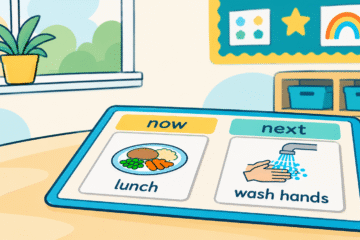
Show as well as tell. Back up your words with a gesture, a sign, a picture, or by modelling the action yourself. Seeing something once can land better than hearing it several times. Key word signing such as Makaton can give a child extra cues, and a Speech and Language Therapist can point you to the signs used in your area.
Value every way a child communicates. Spoken words, gesture, AAC, echolalia, or behaviour, all of it is communication. Respond to the attempt rather than insisting on “use your words,” which a child may not be able to do in that moment. Behaviour is often a message too.
Don’t require eye contact. For many autistic people, making eye contact makes it harder, not easier, to process what is being said. A child looking away is often a child concentrating.
Free behaviour guide - Before You Respond, Behind the Behaviour
Sometimes the clearest sign of a communication breakdown is behaviour. A child who can’t yet make sense of what’s being asked, or can’t tell you what they need, will often show you instead. When that happens, it helps to pause and ask what the behaviour is telling you before you respond to it.
That’s what my free guide, Before You Respond: Behind the Behaviour, is for. It walks you through the moment in a few simple steps: name exactly what you saw, rewind ten minutes to what came just before, and match it to the need underneath, whether that’s communication, sensory, regulation, connection or something else, with a practical “start here” strategy for each.

2 Comments
Colleen Jardine · September 21, 2021 at 1:13 pm
Hi Steph, my name’s Colleen Jardine. I gained a load of knowledge from your post that will be extremely beneficial in dealing with the autistic students that I have in my Grade 2 class. However, the problem that I am faced with is that there are no strategies in place to accommodate their learning needs. These children are placed into mainstream classes with up to 35 students in a class and then basically forgotten about. Two main reasons firstly, because of social pressure parents do not accept that their children have learning difficulties, and secondly, teachers are possibly not skilled in dealing with learning disabilities or have the time to support these students learning needs. Autism spectrum disorder (ASD) includes a range of medical conditions but how do teachers maximize learning outcomes for these students went there is no solid information available nor parental assistance and participation? They are Grade 2 students so there is still time to intervene, however, I am unsure of how to approach school management? How would you go about approach school management to set up a conducive learning environment for these students?
Steph Reed · October 27, 2021 at 11:49 am
Hi Colleen, I would implement as much as you can be yourself. Show management evidence of why these strategies really help (i.e. blog posts, books, research – this will help to show the reasons why and importantly – the impact on children’s outcomes. Good luck.
Comments are closed.